Releasing a song has never been easier. Getting people to actually hear it is another matter. Most independent artists end up with the same scattered setup: a video doing reasonably well on Instagram, a link in bio that goes somewhere generic, a website that hasn’t been touched since the last release, and a Spotify for Artists dashboard that doesn’t seem to move.
The problem usually isn’t any one piece. It’s that the pieces aren’t connected. This guide looks at how to promote a music release so that social media, your website and Spotify work as one journey, using our recent work with Cornwall singer-songwriter Rue and the single ‘Ears’ as a worked example.
Start with a visual identity for the release
Before any posts go out, decide what the release looks like. Not a full rebrand, just a small, consistent set of choices: two or three colours, a typeface or lettering style, and the way the artist name and title appear together.
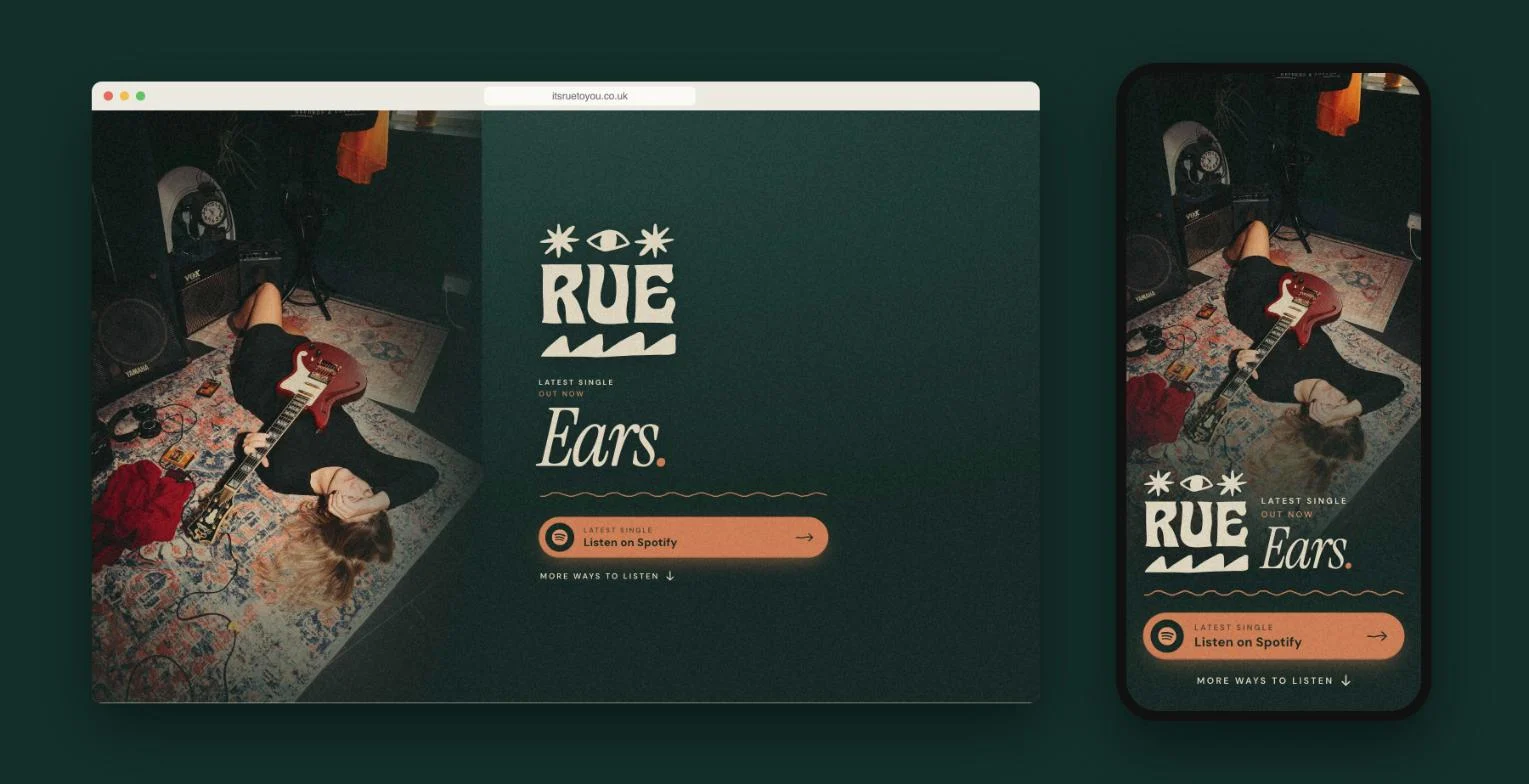
For Rue, that meant a palette of forest green, copper and cream, which runs through the website, the end frames of every video and the social formats. It sounds like a small thing, but when someone sees an ad, taps through and lands on a page that looks like the same world, they trust it. When the colours, type and tone change at every step, people drop off without quite knowing why.
Turn existing footage into social assets
Many artists already have more usable material than they think: a music video, behind-the-scenes clips, a live session. The job is to cut it into assets that work in a feed rather than on a big screen.
A few principles we follow:
- Get to the point in the first second or two. A strong image, a lyric or the hook of the song, not a slow fade in.
- Build for each format. Export a 4:5 version for Facebook and Instagram feeds and a 9:16 version for Stories and Reels, rather than one file squeezed into every placement.
- End with a clear identity. Close on the artist name and release title so the viewer knows what they have just watched and what to search for.
Rue’s promos were edited from original footage filmed by Abbie Barton (@abbie_barton_). We cut several short edits, each built around a different shot and a different line of the song.
Why animated lyrics work
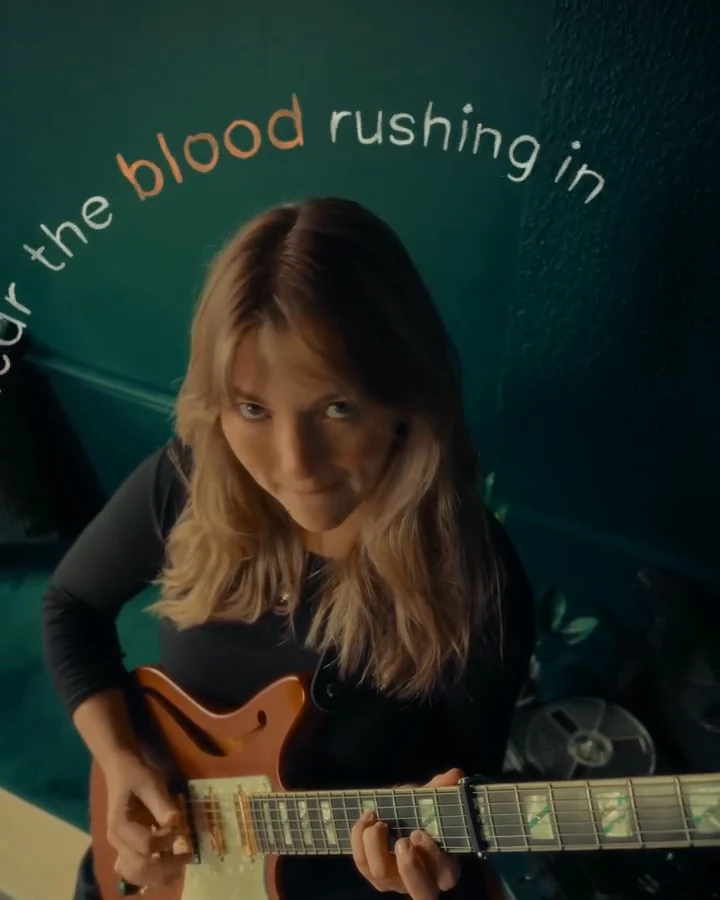
Plenty of people scroll with the sound off. Animated lyrics solve that problem: the words appear in time with the vocal, so a viewer can follow the song even on mute, and those who turn the sound up get the full effect. They also give each edit a natural hook, because the lyric you choose to open with becomes the first thing people read.
Done well, they should feel part of the artwork rather than subtitles laid on top. That means matching the type and colour to the release identity and keeping the motion simple enough that it supports the footage instead of fighting it.
Why an artist website still matters
It’s tempting to treat a link-in-bio page as enough. It is a useful tool, but it only gets someone to a streaming app. An artist website gives them context and a reason to stay: the new release, videos, upcoming gigs, photos and a way to get in touch, all in one place you control.
Spotify itself makes the case for an official site, describing it as a single destination where fans, industry contacts and curators can see what an artist is up to (Spotify for Artists: Do you need a website?). There is also a practical reason. A website is the one place where you can measure what visitors do before they leave for Spotify, which matters a great deal once you start paying for ads.
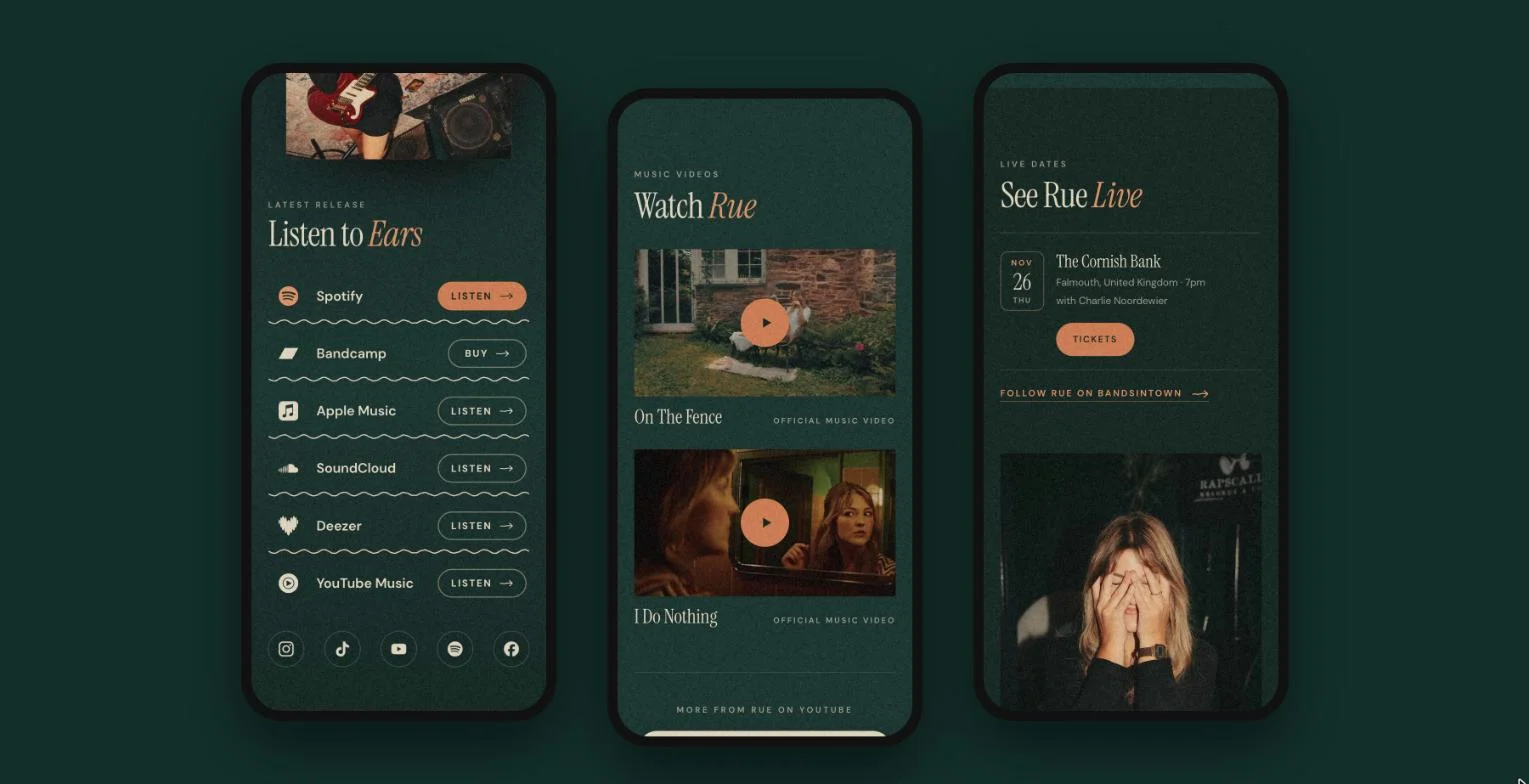
For Rue we built itsruetoyou.co.uk to work first on a phone, because that is where people arrive from social media. The single and streaming links sit at the top, followed by videos, live dates pulled automatically from Bandsintown, and Rue’s own Spotify playlist. If you are weighing up what a site like this should include, our website design page covers how we approach it.
Link in bio or artist website?
A link-in-bio page and an artist website aren’t really competitors. Almost every artist needs one link in their social profiles. The real question is where that link should take people.
When a link-in-bio page is enough
- You have one or two releases and a handful of destinations.
- You need something live today, with no design or build time.
- Your fans mostly stay on social platforms and only need a quick route to streaming.
- You change your links often and want to do it from your phone.
When an artist website becomes more valuable
- You have a growing catalogue, plus videos, photography and live dates to show together.
- Promoters, venues and press need a biography and a clear booking or contact route.
- You want your visual identity to carry through from the post to the page, rather than a standard template.
- You’re running ads and want to see what visitors do on your own site before they leave for Spotify.
- You want a page you own and control at the top of search results for your name.
For Rue, we designed the website to be that single destination: a tap from a post or an ad lands on a branded digital home with the new single, music videos, live dates, a curated playlist and booking details, rather than a plain list of buttons. It was built to take each new release without being rebuilt, so the work done for ‘Ears’ keeps paying off.
Design the journey from social to music
Think of the release as a journey with three steps, each with its own job:
- The post or ad stops the scroll and introduces the song.
- The website gives context and makes the next step obvious, with Spotify one tap away.
- Spotify is where a listener can save the track and follow the artist.
Spotify encourages artists to use their website and social profiles to turn listeners into followers (Spotify for Artists release guide). The more friction you remove between those three steps, the more of your audience makes it to the end.
Test creative on a small Meta budget
You don’t need a large budget to learn something useful from Meta ads, but you do need to ask a clear question. The most useful early question is usually: which video gets the strongest response?
For Rue, we ran two different animated-lyric edits in the same campaign, to the same audience and the same destination. Because everything else is held steady, the creative is the main thing that differs, so the results say something about the videos rather than about the targeting. Once a winner emerges, budget can move towards it, and the next round of content can build on what worked.
A few things that help on a small budget:
- Keep to one objective and one destination.
- Test two or three videos at most, so each gets enough spend to judge.
- Give the test time before making changes. Early results move around a lot.
Our growth work covers how we set up and review campaigns like this.
Measure visits, clicks and streams separately
This is where most release campaigns go wrong. Meta will report link clicks, Google Analytics will report website visits and Spotify for Artists will report streams. They measure different things, and they rarely line up neatly.
- Link clicks show interest in the ad, but some people bounce before the page loads.
- Website visits show who arrived. With cookie consent in place, analytics will only count those who accept, so expect the number to be lower than Meta’s.
- Clicks through to Spotify are the most useful website signal. A custom conversion in Meta can record them, so the campaign is optimised and judged on that action rather than on views.
- Streams are the real outcome, but Spotify for Artists can’t tell you which ones came from an ad. Compare the campaign period with the weeks before it and look at sources such as listeners’ own playlists and the artist profile.
Be honest about what the data can and can’t prove. A rise in streams during a campaign is encouraging, but it isn’t the same as proof that the ads caused it. Rue’s campaign is still running, and we will share what the numbers show once there is enough to say something useful.
Common mistakes to avoid
- Sending ads straight to a streaming app with no context. It can work, but you lose the ability to see what happens in between.
- Using one video file for every placement. Letterboxed video in Stories looks like an afterthought.
- Changing the identity from one step to the next. Consistency is what makes the journey feel trustworthy.
- Judging a campaign on views. Views are cheap. Clicks through to music are what matter.
- Stopping the day the song comes out. Release day is the start, not the finish.
Bringing it together
Promoting a music release well isn’t about doing more. It’s about making the pieces you already have point in the same direction: a clear identity, video cut for the way people scroll, a website that gives the release, and every release after it, a proper home rather than just a list of links, and a small, honest test of what works. It’s the same joined-up approach we take with every client, whatever the sector.
You can see the full project in our Rue case study, or browse more of our work. If you have a release coming up and want the website, content and campaign to work together, start a project with us.